The Information Diet: How Digital Media Shapes What We Consume

What is an “Information Diet”?

Have you ever wondered about how much information you consume every day? Just as food affects our day-to-day lives, the information we consume on social media does too. This is what people call an “information diet.” The idea of an “information diet” is that the content we see online can affect our mental health in the same way that food affects our physical health (NPR, 2012). Constantly consuming negative, misleading, and overwhelming content can affect how we process information, how we feel, and how we see the world.
Living in a Digital Society
Today, we are constantly connected online. Our phones make it very easy to access information at any time and from anywhere. Many people now get their news only from social media platforms (Liedke & St. Aubin, 2024). According to JP Rangaswami, “information is food,” meaning we consume it every day, often without thinking about its source. (Rangaswami, 2012). By consuming an overwhelming amount of information daily, people can experience information overload, with too much content to process. This can lead to major mental health issues and cause someone to have a lot of stress.
How Algorithms Shape What We See
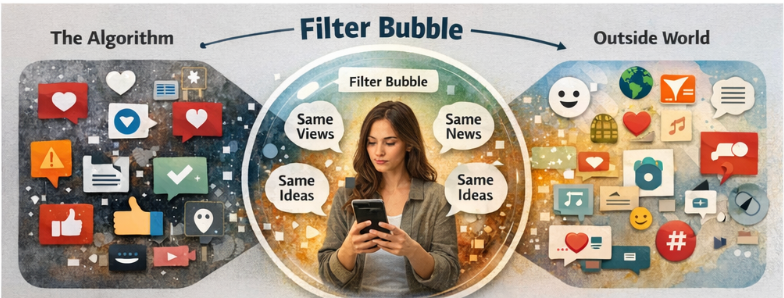
Social media platforms like TikTok, Instagram, and Facebook all use algorithms to shape what content we see. These platforms track our likes, shares, and how long we watch something to keep us engaged on their platform. While in doing so, these platforms make their experience more personal, they can also create what Eli Pariser calls a “filter bubble” (Pariser, 2011). This means we are mostly exposed to content that aligns with our beliefs, which can limit our perspective and keep us seeing the same things over and over again.
Healthy vs. Unhealthy Information Consumption

Having a healthy information diet means being very aware of what you are consuming online. This would include getting your information only from credible sources and limiting your time on social media platforms. On the other hand, an unhealthy information diet is characterized by frequent exposure to misinformation, constant scrolling, and excessive consumption of negative content. Much research shows that doomscrolling on social media can contribute to a lot of stress, anxiety, and negative mental health conditions. (Vidal & Katzenstein, 2024; Robinson & Smith, 2025).
How to Improve Your Information Diet

Improving your information diet doesn’t mean completely cutting off all social media; it means simply being more aware online. Social media doesn’t have to be the “bad guy,” but limiting your use can help improve your mental health. Some simple ways to start doing this are reducing your screen time, spending more time outside your usual content, and setting limits on apps. You can also spend more time offline, such as going for walks, journaling, or hanging out with friends and family.

Personally, I struggled a lot to avoid doomscrolling on social media, but a few things helped me. I have noticed that when I limit my social media screen time and spend less time scrolling when I am bored, I feel less stressed and more aware of the information I consume. These small changes had a big impact on my life and gave me more time to do things I love, like hiking, yoga, and spending more time with my family. Being intentional about what you consume daily can not only improve your mindset but also your overall well-being.
References
Atske, S. (2025). Americans’ social media use 2025. Pew Research Center.
Buchwald, N. (2020). The benefits of a low information diet. Manhattan Mental Health Counseling.
Liedke, J., & St. Aubin, C. (2024). Social media and news fact sheet. Pew Research Center.
Monitask. (2024). What is an information diet?
NPR. (2012). Is it time for you to go on an “information diet”?
Pariser, E. (2011). The filter bubble.
Rangaswami, J. (2012). Information is food [TED Talk].
Robinson, L., & Smith, M. (2025). Social media and mental health. HelpGuide.
Vidal, C., & Katzenstein, J. (2024). Social media and mental health in children and teens. Johns Hopkins Medicine.
World Health Organization. (2021). Global strategy on digital health 2020–2025.


Comments